Is the world on track to meet its climate targets? The answer depends upon who one asks.
A poll of climate scientists earlier this year was not especially optimistic. As the Guardian reported in May:
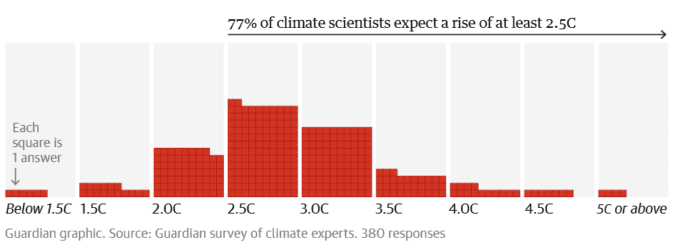
Hundreds of the world’s leading climate scientists expect global temperatures to rise to at least 2.5C (4.5F) above preindustrial levels this century, blasting past internationally agreed targets and causing catastrophic consequences for humanity and the planet, an exclusive Guardian survey has revealed.
Almost 80% of the respondents, all from the authoritative Intergovernmental Panel on Climate Change (IPCC), foresee at least 2.5C of global heating, while almost half anticipate at least 3C (5.4F). Only 6% thought the internationally agreed 1.5C (2.7F) limit would be met.
But whilst scientists are obviously extremely well placed to comment on the process of climate change, the dynamics of how the world tries to combat it are more firmly in the realm of economics. Questions over trade-offs, technology adoption, resource allocation, and incentives are firmly economic in nature.
This week the Clark Center’s European Experts Panel weighed into the debate, asking panel members if “on the basis of current climate policy commitments and potential technology and market responses, my current best estimate for global warming is that average global temperatures by 2100 will rise to no more than 2.5 degrees Celsius above pre-industrial levels”.
The results rather neatly demonstrate the wisdom of giving respondents the option to signal uncertainty rather than forcing a choice.
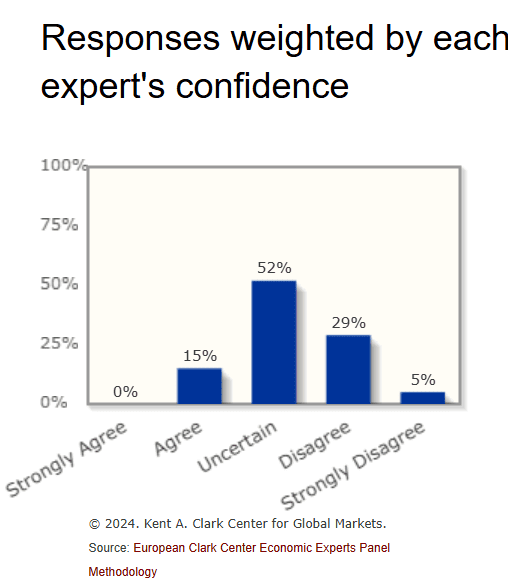
Weighted by confidence, a majority of respondents plumbed for uncertainty with just 15% agreeing with the proposition and more than a third either disagreeing or strongly disagreeing.
The reasons for the uncertainty are understandable. Any question of developments over the coming 75 years will necessarily be subject to a high margin of error. And whilst economists, in general, believe technological change factors over the longer term, it remains exceptionally hard to predict how it will play out.
As Franklin Allen of Imperial College London noted: “It’s very difficult to make these long-term predictions. However, I am more optimistic now than I used to be that this climate target may be met, given the great technological progress being made, particularly in solar cells.” But despite his rising optimism, he remained uncertain.
Partially that uncertainty can be explained by just how many variables are at work. As Olivier Blanchard of the Peterson Institute put it, “I do not know enough even to have a guess. Technological progress is surprisingly fast. But political support and funding is, as would be expected, not sufficient. Which of these two forces will dominate, I just do not know.”.
This is the fundamental problem – the respondents were not just being asked to grapple with the science of climate change and the difficult-to-predict path of technological progress but also how politicians and policymakers will choose to respond.
It can be helpful, under such conditions of uncertainty, to think in terms of scenarios rather than in terms of a central forecast. Both Christian Leuz, of Chicago Booth, and Agnès Bénassy-Quéré, of the Paris School of Economics, pointed to the Network for Greening the Financial System’s (NGFS) recent work in this area.
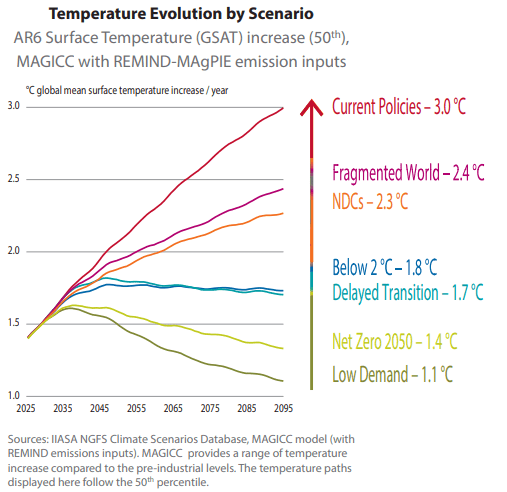
Both Bénassy-Quéré and Leuz agreed with the proposition, based on this analysis. Assuming countries stick with their agreed nationally determined contributions (NDCs) and pledges, the scenarios indicate the rise in global temperatures could be held to under 2.5C.
On the other hand, Richard Reis of the London School of Economics disagreed. He pointed to last year’s report of the Intergovernmental Panel on Climate Change which found a good chance of a higher rise in temperatures.
Perhaps the best case against optimism, is the accumulated carbon already present in the atmosphere. As Lubos Pastor of Chicago Booth put it, “this is quite uncertain, but we are already almost 1.5 degrees above those levels. Given how long carbon persists in the atmosphere, and continued population growth in countries that cannot afford clean energy, it will take time for temperature to change its course”.
Silvana Tenreyro of the London School of Economics was herself uncertain. As she summarised her views: “Governments’ commitment to fight climate change has waned in the past few years; unless they reverse course and efforts (and technologies) improve dramatically, we may drift away from the benign scenarios”. She pointed to helpful research she has authored on this very topic. As her co-authored 2021 paper concluded, “Overall, more ambitious targets and stricter compliance would be needed to offset the large impact of economic and population growth on the flow of emissions and contain a further damaging expansion in the stock of greenhouse gases.”.
The election of Donald Trump, who pulled the United States out of the 2015 Paris climate agreement, in his first term as President has led to much gnashing of teeth about the future of climate adaptation. But as a recent Economist leader noted (paywall) “graphs of global temperature and global emissions do not respond to shifts in administration in single countries”. The United States is obviously a large player in economic terms, but it is not the only one, and 2100 is a long time in the future. Much can change in a decade, let alone decades.
Perhaps it should be no surprise, given the unknowns around technology and policy over the coming decades, that the majority of economists polled expressed uncertainty.