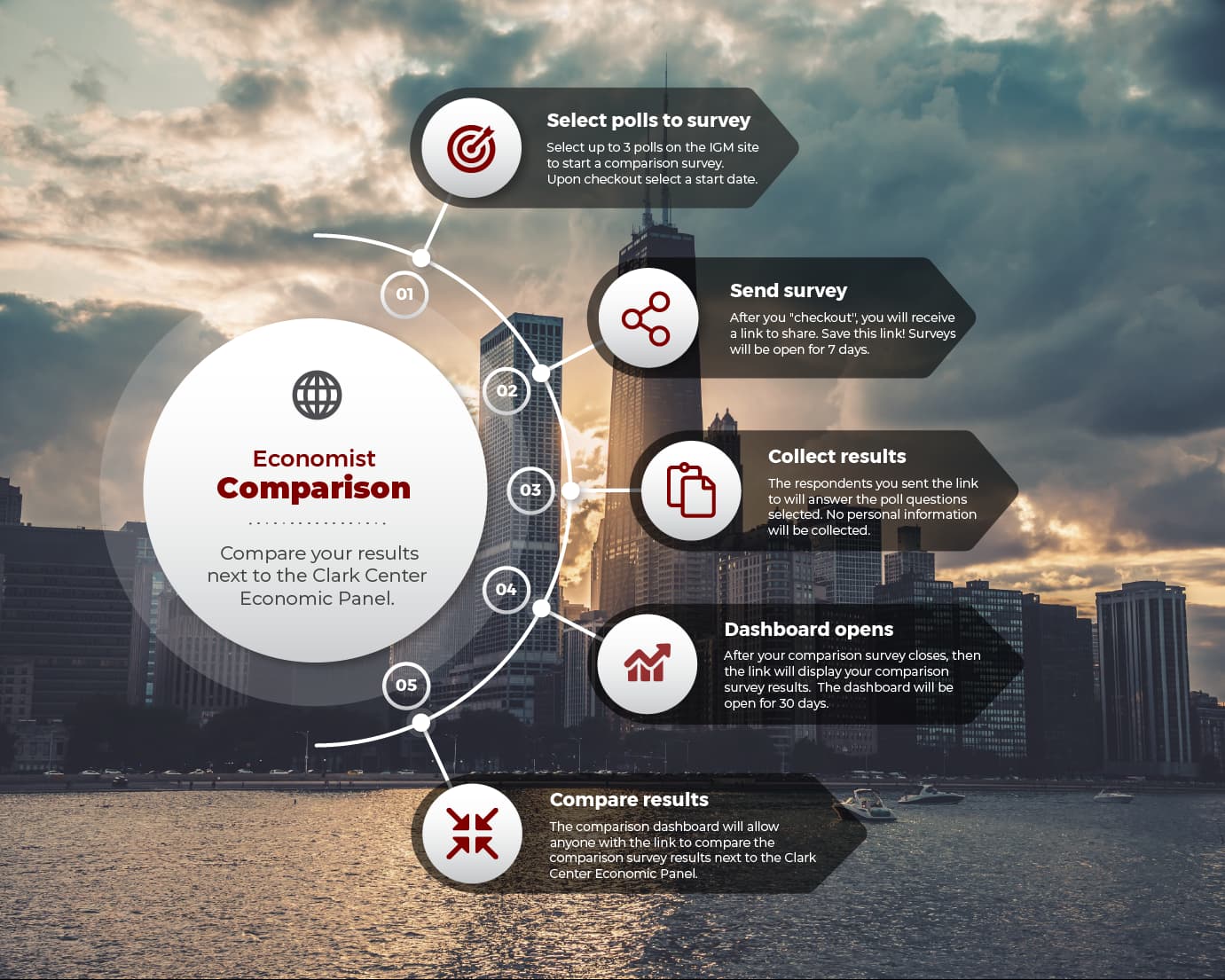
The Clark Center for Global Markets explores economists’ views on vital policy issues via our US and European Economic Experts Panels. We regularly poll over 80 economists on a range of timely and relevant topics. Panelists not only have the opportunity to respond to a poll’s statements, but an opportunity to comment and provide additional resources, if they wish. The Clark Center then shares the results with the public in a straightforward and concise format.
Please note that from September 2022, the language in our polls will use just two modifiers to refer to the size of an effect:
‘Substantial’: when an effect is large enough that it would make a difference that matters for the behavior involved.
‘Measurable’: when the direction of the effect is clear, but perhaps experts would differ as to whether it is substantial.
US regulation of greenhouse gases – including carbon dioxide from motor vehicles and power plants, and methane from oil and gas wells – rests on the Clean Air Act. The Environmental Protection Agency (EPA) recently announced its rescission of the greenhouse gas endangerment finding and motor vehicle greenhouse gas emission standards: https://www.epa.gov/regulations-emissions-vehicles-and-engines/final-rule-rescission-greenhouse-gas-endangerment. The President of the National Academy of Sciences subsequently wrote to the organization's members, noting that 'the EPA justified its decision on legal, economic, and regulatory opinions, and not on the science’.
The weight of economic analysis and evidence supports the conclusion that some form of regulation of greenhouse gas emissions is warranted.
For US consumers and firms, the health and environmental benefits of greenhouse gas emission standards outweigh the costs, making the EPA rescission substantially net negative for American society.
Having the government-sponsored housing agencies Fannie Mae and Freddie Mac buy $200 billion in mortgage-backed securities would measurably improve the affordability of home ownership.
This US survey examines (a) Without extension of the expanded public subsidies for Affordable Care Act healthcare plans, there would be a substantial rise in the number of Americans without health insurance; (b) Losses in the health and well-being of Americans who could no longer afford health insurance in the absence of the subsidies would exceed the savings from the expiration; (c) The possible need for subsidies substantially in excess of those initially provided by the ACA indicates that other changes in the healthcare system are needed to enable broad-based access
This US survey examines (a) The US intervention in Venezuela will have no measurable impact on the world oil price over the next 12 months; (b) The US intervention will lead to a substantial increase in the profitability of US energy companies over the next five years; (c) The US intervention will lead to a substantial increase in economic growth in Venezuela over the next five years
This US survey examines: There are reports that the US strategy in negotiations to end the Russia-Ukraine conflict is prioritizing economic interdependence: https://www.wsj.com/world/russia/russia-u-s-peace-business-ties-4db9b290; (a) Creating expanded mutual business opportunities for American, Russian, and Ukrainian firms would lead to a substantially more stable peace agreement (b) Pursuing economic interdependence without complementary diplomacy (including credible guarantees of Ukraine’s future security) is unlikely to end the conflict and subsequently preserve peace
This US survey examines: Adoption of artificial intelligence will lead to a substantial increase in the growth rates of real per capita income in the US and Western Europe over the next ten years
This US survey examines (a) Freezing the rents paid by tenants of all rent-stabilized apartments in New York for four years would substantially improve the availability of affordable housing for low- and middle-income households; (b) Freezing the rents paid by tenants of all rent-stabilized apartments in New York for four years would be a substantial deterrent to private housing investment in the city; (c) Loosening land-use regulations and other regulation-related constraints on construction in New York (with no rent freeze) would be a substantial boost to private housing investment in the city over the next ten years
This US survey examines (a) The combination of scientific progress, technological innovation, and openness to new ideas underpinned the emergence of sustained economic growth in the Industrial Revolution; (b) The process of creative destruction – in which innovation continually leads to the disruptive displacement of existing jobs, products, firms, and industries – has been a substantial contributor to sustained economic growth
This US survey examines (a) For reducing global greenhouse gas emissions, subsidies for R&D on low-carbon technologies are justified in addition to carbon pricing mechanisms like carbon taxes and cap-and-trade systems; (b) Higher subsidies for R&D on low-carbon energy sources are justified by the fact that their successful deployment would not only reduce emissions but also induce developing countries to substitute away from fossil fuels
This US survey examines (a) US export controls on advanced semiconductor technology and equipment will contribute substantially to maintaining US technological dominance in the industry over the next ten years; (b) US export controls on advanced semiconductor technology and equipment will substantially raise China's presence in the industry over the next ten years; (c) In ten years, historians will judge that the US’s current use of sanctions, export restrictions and tariffs in critical sectors substantially improved the median American citizen’s welfare