This week's IGM Economic Experts Panel statement:
Granting every American citizen over 21-years old a universal basic income of $13,000 a year — financed by eliminating all transfer programs (including Social Security, Medicare, Medicaid, housing subsidies, household welfare payments, and farm and corporate subsidies) — would be a better policy than the status quo.
Universal Basic Income
This week's IGM Economic Experts Panel statement:
The ratio of the 90th to the 10th percentile of the US income distribution has been unaffected by the Federal Reserve’s unconventional monetary policies since the financial crisis.
This week's IGM Economic Experts Panel statement:
The “Cadillac tax” on expensive employer-provided health insurance plans will reduce costly distortions in US health care if it is allowed to take effect as scheduled in 2018.
This week's IGM Economic Experts Panel statements:
The four largest domestic US banks currently have around 40% of the industry’s domestic assets (an average of 10% each). In early 1998, before Glass-Steagall ended and before Citicorp merged with Travelers, they held 13.2% (an average of 3.3% each). Thirty years ago, before interstate branching was fully permitted, that combined share was around 8% (an average of 2% each).
A) Capping US banks’ size so that no single bank could be larger than 4% of the sector's domestic assets would lower systemic risk in the US.
B) The US financial system would contribute more to the average American’s welfare if the size of US banks were capped so that none could be larger than 4% of the sector's domestic assets.
This week's IGM Economic Experts Panel statements:
A) By providing important measures of US economic performance — including employment, consumer prices, wages, job openings, time allocation in households, and productivity — the Bureau of Labor Statistics creates social benefits that exceed its annual cost of roughly $610 million.
B) Cuts in BLS spending would likely involve net social costs because potential declines in the quality of data, and thus their usefulness to researchers and decision makers, would exceed any budget savings.
This week's IGM Economic Experts Panel statement:
An important reason why many workers in Michigan and Ohio have lost jobs in recent years is because US presidential administrations over the past 30 years have not been tough enough in trade negotiations.
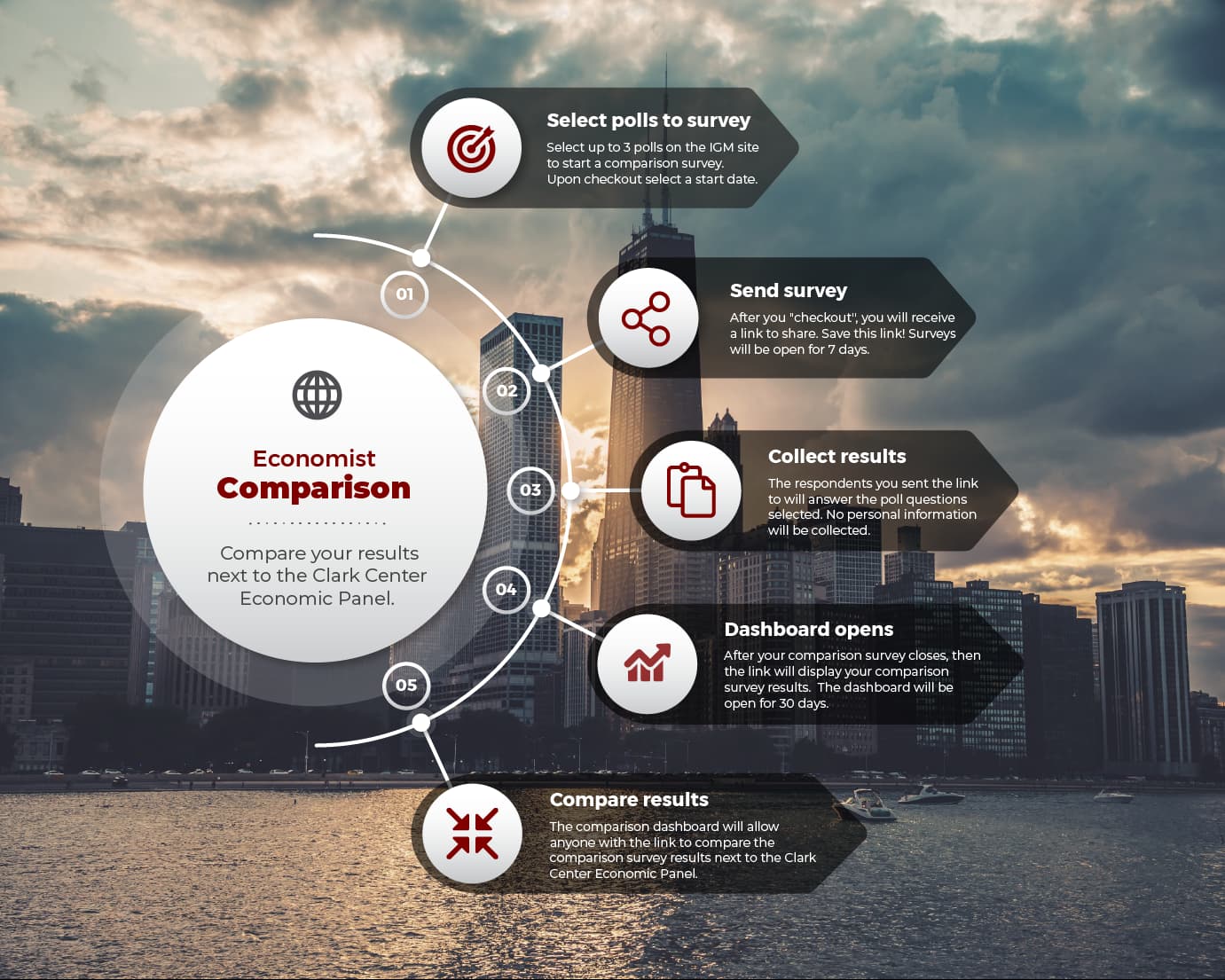
Compare yourself or your peers to the Clark Center Economics Experts Panel