The Fed has a larger balance sheet than was once the case. Dramatically so, as the chart below makes clear.
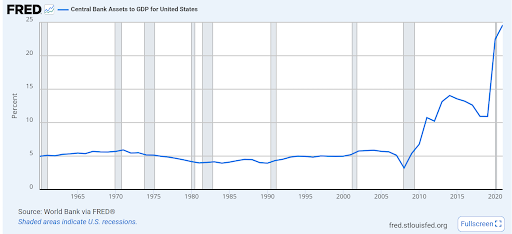
This is a result of a series of policy decisions made over the last two decades; namely three rounds of quantitative easing (QE) carried out between 2008 and 2014; and then an additional period of stimulus during the pandemic in 2020.
The end result has been a balance sheet worth some $6.7 trillion, with two-thirds or so of that made up of US government treasuries.
Chairman Warsh, amongst others, is not especially happy with this inheritance. And this is a position he has held for a long time. A recent note from Citadel looked back at several of his speeches from the late 2000s and 2010 and found a consistent position.
..in a series of speeches: The Federal Funds Rate in Extraordinary Times (2008), Financial Market Turmoil and the Federal Reserve: The Plot Thickens (2008), Longer Days, Fewer Weekends (2009), An Ode to Independence (2010), and Rejecting the Requiem (2010), Warsh articulates four core concerns underlying his skepticism toward prolonged balance-sheet expansion and unconventional monetary policy. First, he argues that as policy rates approached the effective lower bound, the balance sheet became the Fed’s primary policy tool, despite being less transparent and less well understood than conventional rate policy. Second, he contends that sustained balance-sheet expansion significantly enlarged the central bank’s footprint in financial markets. Third, he warns that large-scale purchases of government securities risks mission creep, blurring the line between monetary and fiscal policy and exposing the Fed to political pressure. Finally, he cautions that maintaining policy accommodation for too long risks undermining the credibility of the Fed’s commitment to price stability and, ultimately, de-anchoring inflation expectations.
There is, despite it being a definite theoretical possibility, not much evidence that a larger Fed balance sheet has had much impact on inflation expectations.
…while the Fed holds a substantial $4.4 trillion in Treasuries today, this represents 14% of federal debt in the hands of the public which is actually lower than the Fed share of federal debt 20 years ago. Moreover, if the Fed had not increased its Treasury holdings, its liabilities would also have been lower and the private sector would likely have funded more of the deficit outside of the Federal Reserve system at similar overall interest rates. The reason for high and rising U.S. federal deficits is that American voters elect politicians who are willing to pass legislation to cut taxes and raise spending without paying for it.
That said, it is definitely fair to argue that the whole process of QE and the messy business of unwinding it has somewhat blurred the lines between fiscal and monetary policy in a whole host of advanced economies.
The most interesting aspect of Warsh’s long-standing critique is the idea that a larger Fed balance sheet has increased the Fed’s footprint in financial markets and perhaps impacted their workings.
This was a theme picked up by a recent column in the Economist:
Banks also adapted their businesses to the new regime. When the Fed bought Treasuries from non-bank investors, the proceeds often landed in those investors’ bank accounts as uninsured deposits. This funding in turn allowed banks to expand their investment portfolios and extend more credit. Mr Rajan says this leads to the “ratcheting” effect: each round of QE left banks dependent on a higher level of reserves.
As with draining a reservoir, judging how low the level can now fall without causing collapse is hard. During its first attempt to unwind QE, between 2017 and 2019, the Fed reduced reserves gradually, hoping to leave enough for the financial system to function. But in September 2019 reserves ran short and overnight interest rates spiked. Strains reappeared last year, as reserves neared the low-water mark. The Fed responded by buying Treasury bills at a pace of around $40bn a month from mid-December to mid-April, expanding its balance-sheet again to top up the reserve pool.
The Clark Center’s Finance Experts Panel looked at exactly this sort of issue when they were asked whether “If the Federal Reserve under Kevin Warsh were to reduce its balance sheet by at least $1 trillion over the next 12 months, it would measurably improve the functioning of financial markets over his four-year appointed term as chair”?
Weighted by confidence, around one third of respondents were uncertain, one fifth agreed and around half either disagreed or strongly disagreed.
Stijn Van Nieuwerburgh of Columbia Business School was one of those who agreed, arguing that “A smaller Fed portfolio could improve price discovery and trading by returning securities to private markets, particularly in agency MBS. But runoff also drains reserves and increases the amount of Treasuries that dealers and repo markets must finance. IMO first effect dominates”. Viral Acharya of NYU Stern noted that “It will no doubt depend on how the balance sheet is shrunk, and if not done right, interim liquidity risks could be difficult to manage… but broadly the idea should help remove private sector’s addiction to surplus and always available liquidity, reducing excessive leverage/risk”.
On the other hand, many of those who disagreed specifically argued that one trillion shrinkage over a twelve-month period would be a lot for the markets to absorb. As Andrea Eisfeldt of UCLA Anderson put it, “Reducing the balance sheet by 1TR over a 12 month period could constitute a large supply shock to bond markets. It is not clear that such a supply shock would be absorbed without any impact on the level and volatility of rates. It could also impact money market functioning”.
As Matteo Maggiori of Stanford GSB, who was uncertain, explained, much depends on some hard-to-forecast variables: “Much world depend on doing this in an orderly fashion, on the market conditions, and on the path of conventional monetary policy. The benefits might materialize at horizons longer of 4 years”.
Overall, it is hard to disagree with the Financial Times’s Robert Armstrong, who argued earlier this month that any moves by the Fed to pull back its balance sheet should be handled carefully:
What is the right way to reduce the importance of the balance sheet? Go slowly. Just capping it might be hard enough at first. And as the reserve buffers shrink, do not relieve stress on banks by loosening their liquidity or capital requirements. Banks need more margin for error in a scarce reserve regime, not less.
There may well be a case for shrinking the balance sheet, but setting targets for doing that in advance on a specific timetable is offering up unnecessary hostages to fortune.