This US survey examines (a) The experience of the past 10 years suggests that Western-led economic sanctions do not substantially deter the target countries from their course of action; (b) Had the G7 instituted a complete energy embargo in 2022, Russia's current military and economic position would be substantially worse; (c) Had the G7 instituted a complete energy embargo in 2022, the world economy would have faced substantially higher oil prices
Keyword: import restrictions
a la carte pricing abortion access to credit acquisitions active investing Adam Smith advertising affordability Affordable Care Act Africa agglomeration aging airline industry alternative investments amateurism Amazon American Recovery and Reinvestment Act American Rescue Plan anti-competitive behavior antitrust Argentina artificial intelligence arts asset allocation asset classes asset management asset pricing asset purchases asset returns asset valuation assets AT&T auctions austerity automatic enrollment automation automobile industry autonomous cars
bailouts balance sheet balanced budget bank accounts bank deposits bank failures bank finance Bank of England bank regulation bank runs banking banking crises banking rules banking sector banking union bankruptcy banks bans behavioral economics behavioral finance benefits betting Big Tech Bitcoin board quotas bonds bonuses book market border adjustment tax borrowing borrowing and lending Brexit budget deficits budget scoring bundling Bureau of Economic Analysis Bureau of Labor Statistics bureaucracy business cycles business forecasting business opportunities buy American
cable and satellite TV California Canada cannabis cap-and-trade capital capital allocation capital asset pricing model capital budgeting capital flows capital formation capital income capital markets capital outflows capital regulation capital requirements capital stock capitalism CAPM carbon border adjustment mechanism carbon club carbon emissions carbon leakage carbon prices carbon pricing carbon tax carbon taxes careers CARES Act cars cash catastrophic risk CBDCs central bank independence central bank money central banks CFPB CFTC charitable deductions charity charter schools chief executives childrearing children China Christmas Clean Air Act cleantech climate change climate policies climate policy climate targets closing auction clusters college admissions college athletes college tuition colonialism commercial banks commercial property commitments commodity markets communism compensation competition competition policy competitiveness concentration congestion congestion charges congestion pricing Congress Congressional Budget Office Connecticut consolidation constitutional amendment constitutions construction consumer harms consumer price index consumer prices consumer protection consumer welfare consumption consumption insurance contraception control rights conventions coronabonds Coronavirus corporate boards corporate executives corporate finance corporate governance corporate investment corporate law corporate performance corporate reporting corporate reproting corporate social responsibility corporate tax corporate taxes cost disease cost of capital cost of living cost-benefit analysis costs of living Council of Economic Advisors COVID-19 creative destruction credibility revolution credit credit cards credit ratings credit risk creditors crime crypto assets cryptocurrencies cryptocurrency Cuba culture currencies currency currency manipulation currency reserves customers
data data protection debt debt brake debt ceiling debt obligations debt relief debt support debt sustainability debt-to-GDP ratio decarbonisation default defaults defense defense economics defense spending deflation DEI democracy democratic legitimacy Department of Education dependency ratio deposit insurance destination-based cash flow tax destintation-based cash flow tax Detroit devaluation developing countries developing economies development development assistance development economics digital currency digital economy digital euro digital infrastructure digital markets Digital Markets Act digital money digital platforms digital service providers digital services Digital Services Act digital tokens discount rates discrimination disease diseases disruption distributional effects diversification diversity dollar dollarization dominant firms doom loops drought drug prices drug use duration dutch disease dynamic scoring
early years earnings Eastern Europe economic agents economic data economic development economic geography economic growth economic history economic insecurity economic integration economic performance economic performance; electoral cycles; government policy; political economy; public policy; voters economic policy economic principles economic recovery economic reseach economic research economic statistics economic stimulus Economics 101 economists education educational quality efficiency efficient markets efficient markets hypothesis elections electoral cycles electric vehicles electricity embargoes emerging markets empirical economics employees employment employment contracts employment effects employment protection end-of-day trading energy energy policy energy prices energy sanctions energy subsidies energy supply energy taxes energy transition environment Environmental Protection Agency environmental regulation equal pay equities equity equity injections equity risk premium ESG ESMA essential goods ethanol EU EU budget euro euro exit Europe European Central Bank European champions European Commission European recovery fund European Research Council European Securities and Markets Authority European Union Europen Union Eurozone ex-ante regulation exchange rate adjustment exchange rates exchange-traded products executive compensation expectations experiments export controls export restrictions exports externalities extreme weather
Facebook faculty pay fairness family size Fannie Mae fast-track authority FDIC Federal Economic Statistics Advisory Council federal regulation federal regulations Federal Reserve fee caps fee transparency fees fiat currency fiduciary duty financial crises financial crisis financial markets financial performance financial policy financial regulation financial regulations bank runs financial services financial stability finished good prices firm capabilities firm finances firm location first past the post fiscal benefits fiscal cliff fiscal councils fiscal deficit fiscal deficits fiscal dominance fiscal policy fiscal rules fiscal stimulus fiscal sustainability floods food prices food security forecasting foreign aid foreign direct investment foreign investment fossil fuels fracking France Freddie Mac free markets free movement free trade full capacity fund performance fundamental value fungibility
G7 gambling game theory gasoline gatekeepers GDP GDP growth GDPR gender gaps gentrification geoeconomics geographical mobility geopolitics Germany gift-giving global banking global commerce global financial crisis global minimum tax global minimum tax rate global supply chains global warming globalisation globalization gold Gold Standard golden share Google government government borrowing government budget government budgets government debt government MMFs government policy governments Greece greedflation green technologies green technology green transition greenhouse gases
hard drugs harmonisation health insurance health outcomes healthcare costs healthcare quality healthcare reform hedge funds high-skill workers high-skilled workers higher education hihg-debt countries holidays home insurance home ownership household finances household welfare households housing agencies housing finance housing investment housing markets human capital humanitarian aid hurricanes
ideas illegal activities immigrant visas immigration import duties import restrictions imports impossibility theorem incentives inclusion income inequality income support income tax increasing returns to scale incumbents independent regulatory agencies index funds indexing industrial polic industrial policy Industrial Revolution inequality inflation inflation expectations inflation target inflation-indexed bonds inflation-linked bonds information infrastructure innovation input prices inside information Instagram institutional investors institutions insurance insurance premiums Intel intellectual property interdependence interest rate caps interest rates interest-bearing assets intergenerational mobility intermediate goods intermediation international agreements International Energy Agency international monetary system internet internet: profits investment investment grade investment management investment policy investment portfolio investment returns invisible hand Iran Ireland Italy
labor force participation labor income labor market labor market flexibility labor markets labor productivity labor regulations labor statistics labor supply labour force Laffer curve laissez-faire land use land value tax landlords law and economics legacy preference legal liability legalisation legislative proposals lender of last resort leverage liabilities liberal democracy licensing life expectancy life outcomes liquefied natural gas liquidity listings listings securities exchanges living standard living standards llong-term borrowing loan relief loans lobbying local government lockdowns London long-term borrowing lotteries low-carbon technologies low-income low-income households low-skill workers LTCM Luxembourg
macroeconomic stability macroprudential policy Maine majority rule management practices mandated disclosures manufacturing marginal tax rates marijuana mark to market market anomalies market cap market concentration market dominance market efficiency market indices market intervention market microstructure market power market quality market volatility maturity transformation maximum sustainable employment Medicaid medical debt medical research Medicare medium of exchange mega-banks mental health mergers mergers & acquisitions mergers and acquisitions Mexico Microsoft migration minimum retirement age minimum wage minimum wage|labor market|low-skill workers|unemployment|productivity||||| mismeasurement mobility Modern Monetary Theory monetary policy monetary system money creation money market funds monopsony power moral hazard mortality mortgage-backed securities mortgages museums music events mutual funds
NAFTA Nash equilibrium National Academy of Sciences national debt national security natural disasters natural gas natural resources net neutrality net zero Netherlands network externalities new entry New York Nippon Steel Nobel Prize Nobel Prize in Economic Sciences Nobel Prize in Economics non-bank financial intermediaries non-compete clauses non-tariff barriers Northern Ireland Norway nudge policies
OASI trust fund obesity occupational choice occupational licensing offshore accounts offshoring oil oil prices Omicron online sales online sales tax open economies order execution output gap outsourcing overheating
panics Paris agreement passive investing patent trolls patents payday lending payment services payments system payroll taxes peace peer review Pell grants penalties pension funds pensions personal data personal debt personal finance petrol pharmaceutical industry physical infrastructure physical risks platforms policy advice policy entrepreneurs political appointments political economy pollution populism portfolio allocation portfolio diversification portfolio investment portfolio management portfolio theory Portugal poverty poverty reduction pre-school education prescription drugs President Biden President Obama President Trump price cap price caps price controls price gouging primary voting privacy private credit private equity private firms private funds private schools privatization product quality production production capacity productivity professional sports teams profitability profits prohibition property rights property taxes prosperity protectionism proxy advisory firms proxy voting psychology public corporations public debt public finances public goods public health public investment public ownership public policy public procurement public revenues public schools public spending public transport public utilities publishers purchasing power
R&D R&D spillovers race radiospectrum random audits randomized control trials ranked-choice voting rationality real estate real wages recession reciprocal tariffs reconstruction recovery redemptions redistribution referendum refugees regressive tax regulation regulations remuneration renewable energy renewables renminbi rent control rent freezes rent-seeking repatriated profits research reserve currency resilience resource allocation retail retail investors retaliatory tariffs retirees retirement retirement age retirement benefits return on investment returns returns to education ride-sharing ride-sharing caps risk management risk premia risk-return risk-taking robots rule of law rules runs Russia
safe assets safety sales tax San Francisco sanctions savings school students school vouchers schools Science scientists Scotland Scottish independence SEC secondary markets Section 230 sectoral policies Securities and Exchange Commission security security screening self-control semiconductors services services sector shareholder activism shareholder value shareholders shares shipping short selling single market single-family homes skills slavery small firms smartphones soccer social benefits social cohesion social cost of carbon social costs social integration social justice social media social mobility social norms social problems social programs Social Security social welfare social/public housing socialism sociial welfare soft drinks software industry solar energy solvency sovereign bonds sovereign debt sovereign wealth funds soverign bonds Spain speculation sports Stability and Growth Pact stablecoins stagflation stakeholders standardized tests start-ups state aid state assets state budgets statistical agencies statistics steel steel industry steel tariffs sterling stock buybacks stock market stock prices stock returns store of value strategic behavior strategic oil reserves Strategic Petroleum Reserve strategic planning strategic sectors stress tests student loans students subsidies sugar sugar tax Supplemental Nutrition Assistance Program supplementary leverage ratio supply chain supply chains Supreme Court surge pricing sustainability sustained growth systemic risk
targeting tariffs tax avoidance tax competition tax credits tax cuts tax deductions tax enforcement tax evasion tax harmonization tax incentives tax rates tax reform tax revenues taxes taxis taxonomy taxpayer guarantees teaching tech compaies tech companies tech firms technological change Technology telecommunications telecoms terrorists Tesla test scores testing textbooks theory ticket resale TikTok time consistency Time Warner too big to fail tourism tournaments trade agreements trade balance trade balances trade barriers trade deficits trade embargo trade liberalization trade policy trade sanctions trade war trade wars trading rules training transition economies transparency transport transport networks travel travel bans Treasury bonds Treasury securities tulipmania TV fees twin deficits Twitter
Uber UK Ukraine uncertainty undergraduate economics unemployment unemployment insurance uninsured deposits unions United Nations universal basic income universities urban development urban neighborhoods urban neighbourhoods US states US Steel US Treasuries US Treasury USAID
vaccination vaccines value creation VAT Venezuela venture capital visas volatility voluntary exchange voters
This European survey examines (a) The experience of the past 10 years suggests that Western-led economic sanctions do not substantially deter the target countries from their course of action; (b) Had the G7 instituted a complete energy embargo in 2022, Russia's current military and economic position would be substantially worse; (c) Had the G7 instituted a complete energy embargo in 2022, the world economy would have faced substantially higher oil prices
This US survey examines: (a) Giving the President more direct influence over monetary policy would lead to substantially worse monetary policy decisions; (b) Imposing tariffs results in a substantial portion of the tariffs being borne by consumers of the country that enacts the tariffs, through price increases; (c) There is little empirical evidence that price gouging is causing high grocery prices; (d) Widespread use of price controls creates substantial economic distortions
This week's IGM Economic Experts Panel statements:
A) If all of the “Seven actions to protect American workers” in President-elect Trump’s 100-day plan (see link) are enacted, it will more likely than not improve the economic prospects of middle-class Americans over the next decade.
B) If all of the “Seven actions to protect American workers” in President-elect Trump’s 100-day plan are enacted, it will more likely than not improve the economic prospects of low-skilled Americans over the next decade.
This week's IGM Economic Experts Panel statement:
Adding new or higher import duties on products such as air conditioners, cars, and cookies — to encourage producers to make them in the US — would be a good idea.
This week’s IGM Economic Experts Panel statement:
Past experience suggests that economic sanctions do little to deter the target countries from their course of action.
This week’s IGM Economic Experts Panel statement:
Refusing to liberalize trade unless partner countries adopt new labor or environmental rules is a bad policy, because even if the new standards would reduce distortions on some dimensions, such a policy involves threatening to maintain large distortions in the form of restricted trade.
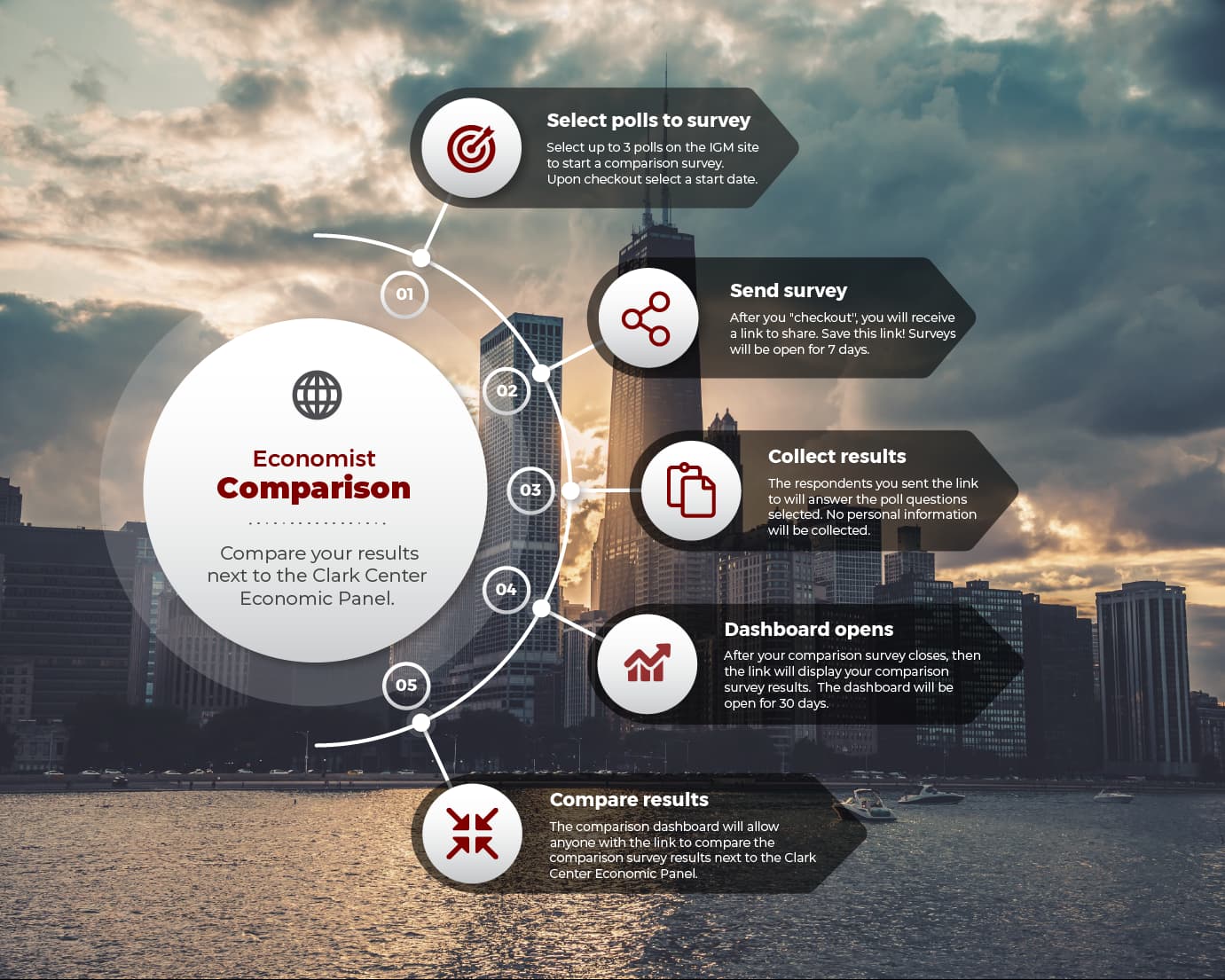
Compare yourself or your peers to the Clark Center Economics Experts Panel